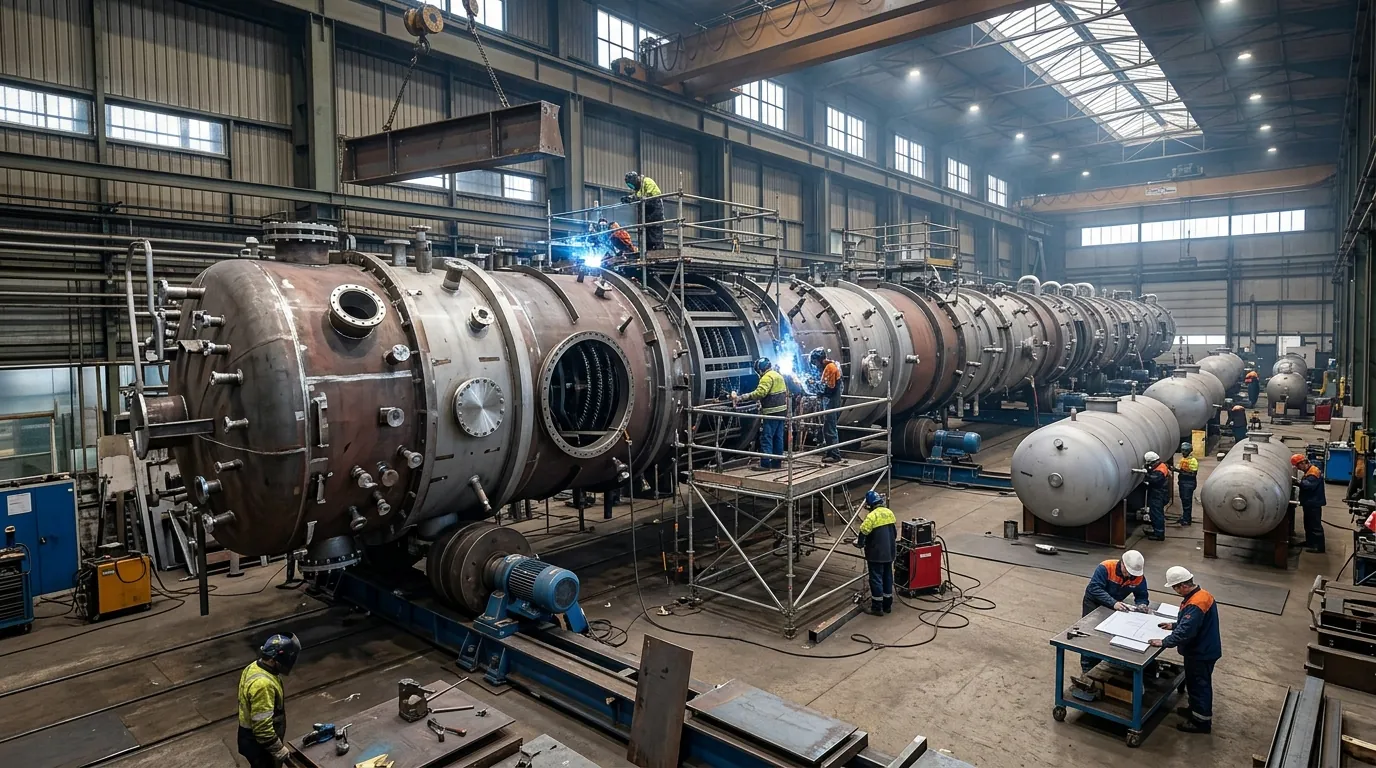
If you work in refining, chemical processing, or natural gas, you already know that not all fabrication scopes are created equal. A separator drum and an atmospheric distillation column may both fall under ASME Section VIII, but the engineering, tolerances, sequencing, and shop execution behind each one look very different. Distillation column fabrication is a specialized discipline, and treating it like a standard pressure vessel order is one of the fastest ways to introduce risk into a project.
This article breaks down those differences in practical terms, because understanding what goes into a column helps you ask better questions, write better specifications, and choose the right fabricator before a schedule or quality problem shows up.
Table of Contents
They Both Start with ASME, But That’s Where the Similarities End
Standard pressure vessels, think separators, drums, reactors, and accumulators, are designed primarily to contain pressure. Their fabrication centers on material selection, shell thickness, head design, nozzle reinforcement, and weld quality. Once the shell is built, hydrotested, and documented, the vessel is complete.
A distillation column starts there and adds an entirely different layer of complexity. Yes, it is a pressure vessel. Yes, it must meet ASME Section VIII requirements. But the column also has to function as precision separation equipment. That means the shell itself is not the final product. It is the housing for a highly engineered internal system, and the performance of that internal system depends on how accurately the shell is built.
When you fabricate a standard vessel, you are building a container. When you fabricate a distillation column, you are building an instrument that happens to be the size of a building.
Shell Geometry Matters More Than Most Buyers Realize
For a standard pressure vessel, shell out-of-roundness tolerances are driven by code requirements for pressure-containing service. Those tolerances are meaningful, but they primarily protect structural integrity.
For a trayed tower or distillation column, the tolerances serve a second purpose: they protect process performance. Tray installations require consistent shell diameter throughout the column height. If a section of the shell is out of round, trays may not seat properly, downcomer clearances may vary, and vapor distribution across the tray deck becomes uneven. That creates channeling, premature flooding, and separation efficiency losses that can affect an entire process unit.
This is why fabricators experienced with columns pay close attention to shell course alignment and roundness at every course, not just at nozzle locations. The tolerances are verified not once but repeatedly throughout the build.
Plumb is a related concern. A tall column must be fabricated with enough attention to straightness that it installs and operates within the verticality tolerances required for tray function. Even small deviations can compound over 60 or 80 feet of shell height.
Internal Support Structures Change the Entire Fabrication Sequence
A pressure vessel typically has internal components that are either simple or absent. You might have a demister pad, a vortex breaker, or a catalyst support grid. These are important, but they do not fundamentally reshape how the vessel is built.
A distillation column is a different story. Tray support rings are welded to the inside of the shell at precise elevations throughout the height of the column. Each ring must land at the correct location relative to the others, maintaining consistent tray spacing specified in the process design. If tray spacing varies from what was designed, the vapor and liquid traffic between stages is disrupted.
This means the fabrication sequence for a trayed tower must account for internal welding before courses are closed, accessible positions for fit-up and inspection, and a systematic check of ring elevation and levelness at every stage. Fabricators who are used to building vessels without internal tray rings sometimes underestimate this sequence, and the result is rework that is difficult and expensive to correct once the shell is assembled.
In some cases, columns are also fitted with intermediate draws, chimney trays, or packed sections in addition to trayed sections. Each adds another layer of internal coordination and fabrication planning.
Nozzle Orientation Is a Process Engineering Issue, Not Just a Fabrication One
On a standard pressure vessel, nozzles are oriented primarily to match piping layouts and ease of maintenance access. Orientation is important, but there is usually some flexibility.
On a distillation column, nozzle orientation and elevation are directly tied to process function. Feed nozzles, vapor return lines, liquid draw-offs, reboiler connections, and condenser returns all enter and exit at specific locations dictated by the process flow design. Getting a nozzle elevation wrong by even a few inches can change the effective feed point or alter the liquid level at a tray draw, with real consequences for column operation.
This means the fabrication team must work closely with the process and mechanical engineering documents, and any dimensional changes must be flagged and resolved rather than absorbed. Tight document control is not a bureaucratic requirement here. It is a direct contributor to whether the column works as designed.
Size and Transport Are Fabrication Constraints, Not Just Logistics
Most standard pressure vessels can be fabricated in sections, flanged for field assembly, or shipped whole without major coordination challenges. Tall distillation columns operate differently.
Many columns are 80, 100, or even 200 feet tall. That means they may need to be fabricated in multiple sections and field-assembled on site, or transported as a single unit on an over-dimensional haul requiring route surveys, permits, and coordination with local authorities. The fabricator needs to plan for this during the design phase, not after the vessel is complete.
Weld seam locations, tray ring positioning, and lifting lug placement must all account for whether the column ships in one piece or multiple sections. If field welds will be required, the fabricator must specify weld joint details, match-marking, and NDE requirements for those joints. This is work that does not exist for most standard vessel orders.
Documentation Requirements Are Elevated and More Process-Specific
Both vessel types require ASME data reports, material certifications, NDE records, and hydrostatic test documentation. That baseline is the same.
But a distillation column typically involves a thicker documentation package that includes tray installation records, dimensional inspection reports for internal components, elevation checks for support rings, and in some cases witness hold points for the column owner’s inspector at multiple stages of fabrication.
For columns going into critical service at refineries or chemical plants, documentation is not just a compliance requirement. It is the record that allows operations and reliability engineers to understand what was built, verify it against the design intent, and use it as a baseline for future inspections and troubleshooting.
A fabricator who treats documentation as an afterthought is one you want to avoid on a column project, regardless of how competitive their price is.
Why Fabricator Experience Matters More on Column Projects
The technical differences above explain why distillation column fabrication rewards experience in a way that not every vessel type does. A fabricator who primarily builds horizontal drums and separators may be qualified under ASME, but their shop procedures, weld sequencing, quality checkpoints, and internal fabrication workflows may not be designed for the precision a tall vertical column requires.
Before placing a column order, it is worth asking a fabricator directly about their history with similar scope. How many trayed towers have they built? What diameters and heights? How do they handle tray ring elevation verification? What is their approach when a dimensional discrepancy is discovered mid-build?
A fabricator who can answer those questions specifically and clearly has built columns before. One who gives a general answer about ASME certification and quality programs probably has not built many.
The Takeaway
Distillation columns and standard pressure vessels share a code framework, but they are not the same fabrication scope. Columns require tighter dimensional control, internal coordination that shapes the entire build sequence, process-specific nozzle accuracy, and documentation depth that reflects their role as core process equipment.
If you are specifying, procuring, or engineering a column project, the differences outlined here are worth building into your vendor qualification process and your RFQ requirements. The fabricators who understand these distinctions are the ones who will deliver a column that performs as designed, not one that just passes a hydrostatic test.